
Bright, floral and just a little bit nostalgic, this lemon lavender cake brings together sunny citrus and the delicate perfume of lavender in a tender, moist crumb. I first made it for a spring brunch when fresh lemons were abundant and a friend gifted me a small jar of culinary lavender. The result tasted like sunshine — not overly floral, with a bright lemon zing that keeps each bite lively. If you enjoy lemon-forward bakes, you might also enjoy lemon blueberry cake as another spring-summer option.
Why you’ll love this dish
This cake balances two flavors people often worry about: lemon can be too sharp, and lavender can be so perfumed it overwhelms. Here, measured lavender and fresh lemon zest play supporting roles to a classic butter cake base. It’s perfect for occasions where you want something a little elevated but not fussy — think afternoon tea, Mother’s Day, bridal showers, or a weekend dessert when you want guests to feel pampered.
“A light, fragrant cake with real lemon brightness and a gentle lavender note. Not cloying, just elegant.”
Reasons to try it:
- Quick enough for a weekend bake but special enough for guests.
- Uses pantry staples plus dried lavender — no unusual ingredients required.
- Kid-friendly texture (the scent is subtle) but grown-up flavor profile.
- Freezes well, so you can make ahead for celebrations.
Step-by-step overview
Before you measure and mix, here’s the simple flow so you know what to expect: cream butter and sugar until light; add eggs and lemon for lift and aroma; whisk dry ingredients with lavender and fold them into the wet mixture, alternating with milk to keep the batter tender; bake in two 9-inch pans; cool, then frost with lemon or lavender frosting. The whole process is straightforward and well suited to bakers who want clarity in each step.
In short:
- Preheat, prep pans.
- Cream butter + sugar.
- Add eggs one at a time, then lemon.
- Combine dry ingredients including lavender.
- Alternate dry mix with milk into wet mix.
- Bake, cool, frost.
What you’ll need
- 2 cups all-purpose flour
- 1 1/2 cups sugar
- 1/2 cup unsalted butter, softened
- 3/4 cup milk
- 4 large eggs
- 1 tablespoon dried lavender
- 2 tablespoons lemon zest
- 1 tablespoon baking powder
- 1/2 teaspoon salt
- 1/4 cup lemon juice
Ingredient notes and substitutions:
- Dried lavender: Use culinary-grade lavender only. If you prefer milder florals, reduce to 2 teaspoons. Lightly crush the buds in a mortar to release aroma before mixing.
- Butter: For best flavor, use unsalted and add a pinch more salt if using salted butter.
- Milk: Whole milk gives a richer crumb. For a lighter cake, use 2% milk. For dairy-free, swap milk for unsweetened almond milk and use dairy-free butter.
- Lemon: Use organic lemons if you’ll be using the zest. Grate only the bright yellow part, not the bitter white pith.
Step-by-step instructions
- Preheat your oven to 350°F (175°C). Grease and flour two 9-inch round cake pans, tapping out excess flour. Line bottoms with parchment for easy release.
- In a large mixing bowl, cream the softened butter and sugar together until light and fluffy, about 3–5 minutes with a hand mixer. Scrape the bowl once.
- Add the eggs one at a time, mixing well after each addition so the batter stays emulsive and smooth. Stop and scrape the sides.
- Stir in the lemon zest and lemon juice. Mix just until incorporated; overmixing reduces fluff.
- In another bowl, whisk together the flour, baking powder, salt, and dried lavender. Sifting is optional but helps distribute the lavender evenly.
- Gradually add the dry ingredients to the wet mixture, alternating with the milk: start and finish with the dry ingredients. Stir gently until just combined. Do not overbeat.
- Divide the batter evenly between the prepared cake pans. Smooth the tops with a spatula. Tap pans once on the counter to remove large air pockets.
- Bake for 25–30 minutes, or until a toothpick inserted into the centers comes out clean or with a few moist crumbs. Rotate the pans halfway through if your oven has hot spots.
- Allow the cakes to cool in the pans for 10 minutes, then run a knife around the edges and turn the cakes out onto wire racks to cool completely. Cooling fully prevents the frosting from sliding.
- Frost with your favorite lemon or lavender frosting. A simple lemon cream cheese or buttercream with a touch of lemon juice brightens the flavors.
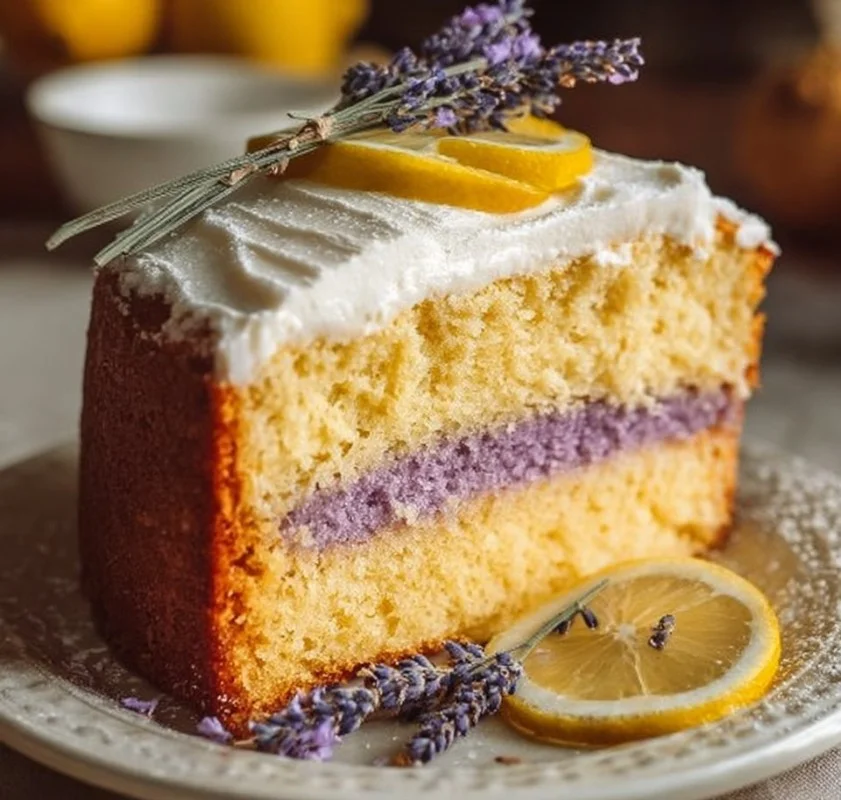
: Photo suggestion — a sliced cake on a white plate, garnished with thin lemon slices and a sprig of lavender.
Best ways to enjoy it
This cake shines when kept simple. Serve thin slices at room temperature so the lavender aroma reads subtly. Pairing ideas:
- Drinks: Earl Grey or green tea complements the floral notes. A cold sparkling elderflower or Prosecco makes it festive.
- Sauces and sides: A light honey drizzle or a spoon of lemon curd on the side intensifies the citrus. Fresh berries (raspberries or blueberries) add color and a contrasting tartness.
- Presentation: Stack two layers with a thin lemon curd layer between them, then apply a semi-naked frosting finish and top with candied lemon peel or a few lavender buds (use sparingly).
Serve it for brunch with tea, as a light dessert after a lemon-forward meal, or as an afternoon pick-me-up with coffee.
Storage and reheating tips
Short-term storage:
- At room temperature: Keep frosted cake covered loosely with a cake dome for up to 48 hours. Avoid airtight wrap for frosted cakes to protect decoration.
- In the refrigerator: Store in an airtight container for up to 5 days. Bring slices to room temperature before serving to restore texture and flavor.
Freezing:
- Unfrosted layers: Wrap individually in plastic wrap, then aluminum foil. Freeze up to 3 months. Thaw overnight in the fridge, then bring to room temperature before frosting.
- Frosted cake: Freeze for up to 2 months. Flash-freeze on a tray, then wrap tightly. Thaw in the fridge before bringing to room temp to avoid condensation on the frosting.
Reheating:
- For single slices, warm for 10–15 seconds in a microwave (on low power) or 5–7 minutes at 300°F in a toaster oven until just warm. Avoid overheating to prevent dryness.
Food safety: Because this cake contains eggs and dairy, do not leave slices at room temperature for more than 2 hours in warm conditions. When in doubt, refrigerate.
Helpful cooking tips
- Measure flour correctly: spoon it into the cup and level it off. Too much flour equals a dense cake.
- Don’t skip tempering the lavender: if you’re nervous about the floral intensity, grind the dried buds slightly and taste a pinch with sugar before mixing. The aroma will indicate strength.
- Room-temperature ingredients: Ensure eggs and butter are at room temperature for proper emulsion and rise. Cold ingredients cause batter to curdle.
- Zest, don’t juice: For maximum aroma, zest first, then juice the lemons. Zest is more concentrated in essential oils.
- Test doneness: Use the toothpick test; a few moist crumbs are better than a dry center. A slightly underbaked center will finish as the cake cools.
Creative twists
- Lavender glaze: Make a thin lavender-infused glaze by steeping 1 teaspoon crushed lavender in 1/4 cup heavy cream, then strain and mix into powdered sugar with lemon juice. Brush over cooled cake.
- Blueberry swap: Fold 1 cup fresh blueberries into the batter for a lemon-blueberry version. Toss berries in a tablespoon of flour to prevent sinking.
- Olive oil variation: Replace half the butter with high-quality extra-virgin olive oil for a lighter, mediterranean crumb; reduce baking time slightly.
- Honey-lemon frosting: Replace some powdered sugar with local honey for a complex sweetness that pairs well with lavender.
- Gluten-free: Use a 1:1 gluten-free flour blend with xanthan gum. Expect a slightly different texture but similar flavor.
FAQ
Q: How long does prep and bake time take?
A: Prep is about 20–30 minutes; bake time is 25–30 minutes. Allow an extra 30–60 minutes for cooling before frosting.
Q: Can I use fresh lavender instead of dried?
A: Use dried culinary lavender for predictable flavor. If using fresh lavender, reduce the amount to 1–2 teaspoons finely chopped, since fresh herbs can be more aromatic and contain more moisture.
Q: Is this cake very floral?
A: No — when measured as written, lavender adds a subtle perfume rather than an overpowering taste. Reduce to 2 teaspoons if you are especially sensitive to floral flavors.
Q: Can I make this into cupcakes?
A: Yes. Fill liners two-thirds full and bake 16–20 minutes. Check with a toothpick for doneness.
Q: How should I frost the cake if I want a stronger lemon flavor?
A: Make a lemon curd layer between the cakes and a lemon buttercream frosting with extra lemon juice and zest. Balance the acidity with powdered sugar to maintain spreadability.
This lemon lavender cake is a reliable recipe to keep in your repertoire when you want a show-stopping yet approachable dessert. With a few small adjustments you can tune the floral and citrus notes to your taste and create a cake that suits everything from casual teas to celebratory dessert tables.
Print
Lemon Lavender Cake
- Total Time: 60 minutes
- Yield: 8 servings 1x
- Diet: Vegetarian
Description
A bright and floral lemon lavender cake that balances citrus zing with delicate lavender notes, perfect for spring gatherings.
Ingredients
- 2 cups all-purpose flour
- 1 1/2 cups sugar
- 1/2 cup unsalted butter, softened
- 3/4 cup milk
- 4 large eggs
- 1 tablespoon dried lavender
- 2 tablespoons lemon zest
- 1 tablespoon baking powder
- 1/2 teaspoon salt
- 1/4 cup lemon juice
Instructions
- Preheat your oven to 350°F (175°C). Grease and flour two 9-inch round cake pans.
- Cream the softened butter and sugar together until light and fluffy, about 3–5 minutes.
- Add the eggs one at a time, mixing well after each addition.
- Stir in the lemon zest and lemon juice until just incorporated.
- Whisk together the flour, baking powder, salt, and dried lavender in another bowl.
- Add the dry ingredients to the wet mixture, alternating with milk.
- Divide the batter between the prepared cake pans and smooth the tops.
- Bake for 25–30 minutes, or until a toothpick comes out clean.
- Allow the cakes to cool in the pans for 10 minutes, then turn out onto wire racks.
- Frost with your favorite lemon or lavender frosting.
Notes
Use culinary-grade lavender only. Store unfrosted layers wrapped in plastic for up to 3 months.
- Prep Time: 30 minutes
- Cook Time: 30 minutes
- Category: Dessert
- Method: Baking
- Cuisine: American
Nutrition
- Serving Size: 1 slice
- Calories: 350
- Sugar: 28g
- Sodium: 200mg
- Fat: 14g
- Saturated Fat: 8g
- Unsaturated Fat: 4g
- Trans Fat: 0g
- Carbohydrates: 50g
- Fiber: 2g
- Protein: 6g
- Cholesterol: 120mg
Keywords: cake, lemon, lavender, spring dessert, floral dessert